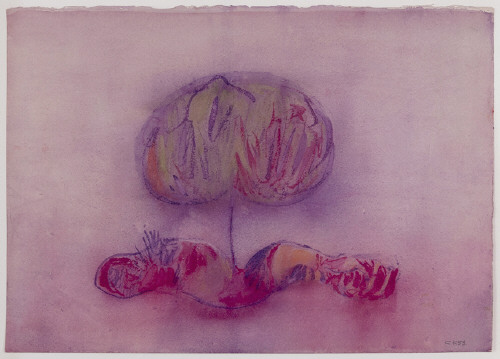
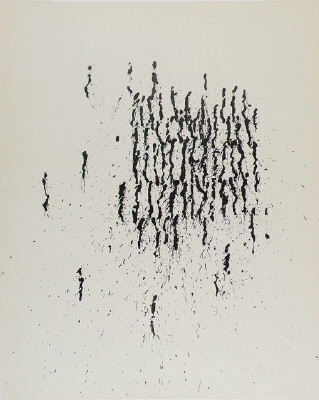
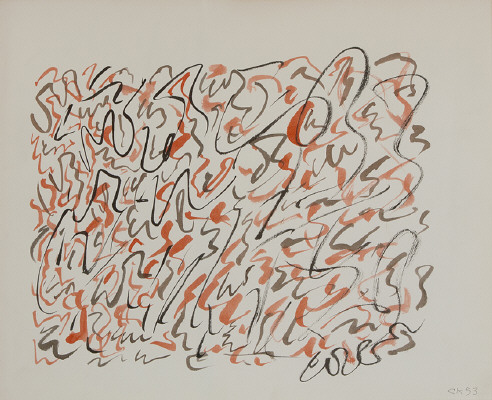
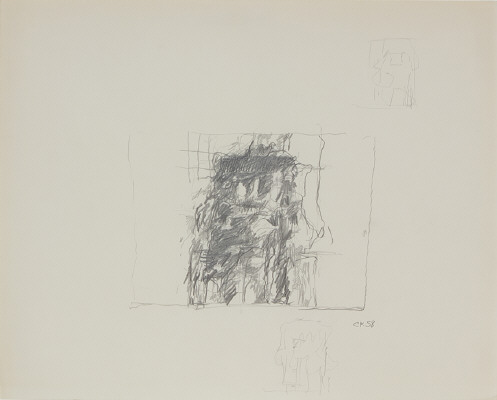
Craig Kauffman (U.S., 1932-2010) is considered to be one of the most inventive American artists of the postwar era. Often cited as a seminal figure in the Los Angeles art world during the 1950s and 1960s, Kauffman rose to the attention of critics and collectors with his first one-man show of paintings at Landau Galleries in Los Angeles in 1953. His exhibitions at the legendary Ferus gallery, from 1958 through 1965, inspired the clean, cool abstraction that defines the period in modern art from Los Angeles.
Although he is often associated with movements in Los Angeles art, his work was always informed by a broad historical knowledge of European painting and Asian art. Often working in series, Kauffman continued to explore unorthodox supports for painting during the 1970s, 1980s and 1990s. Using materials ranging from acrylic plastic to silk, Kauffman always maintained a sensuous, high-key use of color. During his six-decade career, he continued to exhibit both in the U. S. and internationally.
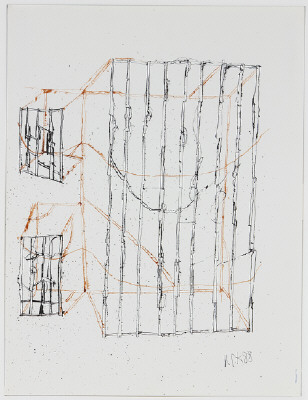
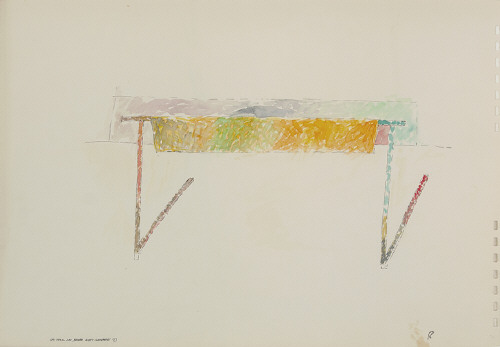
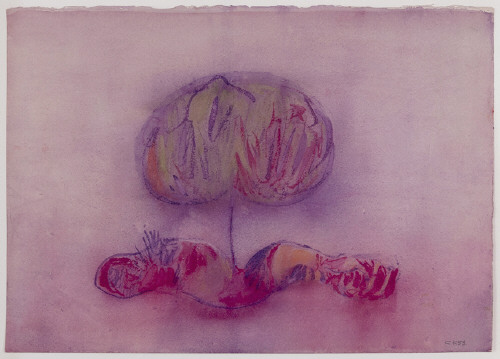
Craig Kauffman is widely recognized for his six decades of paintings, drawings, and prints. Characterized by an obsessive pursuit of sensuality within the structure of painting, Kauffman’s engagement with unconventional materials and techniques defies categories. Throughout his prolific career, Kauffman challenged conventions, as he merged his interests in abstraction, color and perception. Although he has been associated with critical groupings such as Finish Fetish and Light and Space, Kauffman’s work precedes those categories, and his work substantially transcends their limitations.
Even at the age of 20, Kauffman’s 1953 solo exhibit at Landau Galleries was favorably reviewed by Jules Langsner in Art News. Kauffman was one of the original members of the legendary Ferus Gallery, and participated in the opening show, Objects on the New Landscape Demanding of the Eye. Critics and his peers regarded Kauffman’s first solo show at Ferus in June of 1958 as a major and influential exhibition of painting.
However, it was Kauffman’s wall relief paintings on acrylic plastic that gained him international attention and fame. After an initial group of works with flat plastic, Kauffman discovered the industrial process of vacuum forming, and proceeded to translate his sensuous forms into wall reliefs, painted on the reverse with sprayed acrylic lacquer. The works were shown first at Ferus, and subsequently by Pace Gallery in New York, where they were well received. By the summer of 1966, Kauffman’s acrylic plastic wall relief paintings were featured on the cover of Art in America. Kauffman would go on to participate in 57 exhibitions in New York during his career.
Kauffman continued to exhibit at Pace in New York, and by 1967 his work had been acquired by the Whitney Museum of American Art. In 1969 the Museum of Modern Art added Kauffman’s work to the collection, an acquisition by curator Kynaston McShine. In what the artist considered to be the most accurate curatorial statement about his work, historian and critic Barbara Rose included Kauffman in A New Aesthetic at the Washington Gallery of Modern Art, along with seminal Minimal artists Donald Judd, Dan Flavin, and Kauffman’s colleagues Larry Bell, Ron Davis and John McCracken. As Rose noted in her catalogue essay, "Shaping the brittle sheet plastic into a series of voluptuous curves, Kauffman achieves a kind of abstract eroticism that is purely visual."
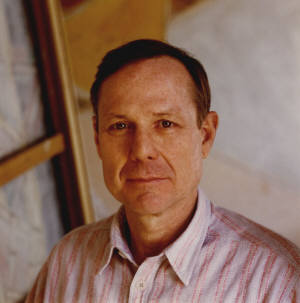
Born in Los Angeles on March 31, 1932, Robert Craig Kauffman enrolled in the School of Architecture at the University of Southern California, but transferred to the Department of Art at UCLA in 1952, where he received his Bachelor of Fine Arts degree in 1955 and Master of Fine Arts in 1956. Kauffman traveled and lived in Paris and New York during subsequent years, and also taught painting at the University of California Irvine from 1967 to the early 1990s. Eventually, he took up residence in the Philippines, where he continued to work in a home and studio that he designed, until his passing in May of 2010. His work is in the collections of over 38 museums worldwide.
Recent exhibitions include Crosscurrents in Painting and Sculpture, 1945—1980, J. Paul Getty Museum and the Martin Gropius Baü, Berlin; Phenomenal: California Light, Space, Surface, Museum of Contemporary Art San Diego; Hot Spots, Kunsthaus Zurich; Time & Place: Los Angeles 1957—1968, Moderna Museet; and Pop Art Design, Vitra Design Museum, Louisiana Museum, and Moderna Museet. Kauffman’s work was also a significant part of major surveys including Sunshine and Noir, Louisiana Museum in 1997 (which traveled throughout Europe); A Minimal Future? Art as Object 1958—1968, Museum of Contemporary Art, Los Angeles in 2004; and Los Angeles, Birth of an Art Capital 1955—1985, at the Centre Pompidou in 2006.
Kauffman’s work is included in the permanent collections of major museums around the world, including the Museum of Modern Art, New York; the Louisiana Museum, Humlebaek, Denmark; the Whitney Museum of American Art, New York; the Los Angeles County Museum of Art; The Tate Modern, Liverpool; the Museum of Contemporary Art, Chicago; the Museum of Contemporary Art, Los Angeles; and the Art Institute of Chicago.
Museum Collections
- Albright-Knox Art Gallery, Buffalo, New York
- The Art Institute of Chicago, Chicago, Illinois
- Bennington College, Bennington, Vermont
- Carnegie Museum of Art, Pittsburgh, Pennsylvania
- Chazen Museum of Art, Madison, Wisconsin
Selected Solo Exhibitions